
Roof inspections in Toronto. Reports a lender will accept.
Most roofing companies install. Very few properly diagnose. Physical core sampling, attic inspections, and a highly trained eye find what a quick walkover misses.
Most roofing companies install. Very few properly diagnose. An inspection that produces a defensible number is a different exercise from a walk-around that ends in a replacement quote, and the two get confused often enough that it is worth stating the difference plainly.
Ours involve physical roof access, the attic wherever there is hatch access, and a written report inside 24 hours. On flat roofs that includes core sampling to check membrane saturation and deck condition, because trapped moisture is not visible from the surface and no amount of looking will reveal it.
What the inspection actually covers
On a sloped roof: flashings at every wall and chimney intersection, valley condition, pipe boots, the eave detail where ice damming does its work, and the state of the shingle field measured by granule loss and sealant bond rather than by age.
Then the attic, which is frequently more informative than the roof and is the part most inspections skip. Staining on the underside of the deck that maps to a flashing above, frost or water marks at the nail points that indicate condensation rather than a leak, and whether the soffit intake is clear or has been packed shut by a later insulation upgrade. A roof that keeps failing early is usually telling you about the attic underneath it.
Pre-purchase inspections
On a resale property the roof is usually the largest single unknown in the transaction, and a general home inspection tends to describe it from the ground in a sentence. On a purchase where the next roofing cycle costs $9,000 to $22,000, that is not enough information to waive a condition against.
We schedule around condition deadlines rather than around our own calendar, and the report follows within 24 hours so it is in your hands while it can still change what you offer. What you get is a number you can negotiate with: remaining life with the reasoning attached, near-term repair items separated from the eventual replacement, and a cost range against each.
Reports that lenders and insurers accept
A report is only useful if the person receiving it will act on it. Dated photographs keyed to their location on the roof, each deficiency described by failure mode rather than by a severity adjective, a remaining-life estimate with the reasoning shown, and a priority split between what needs doing now and what can be budgeted for.
That format came from the two audiences who reject vague reports fastest. A lender financing a building wants a defensible number for remaining envelope life. An adjuster wants cause and date, because a claim turns on whether damage was sudden or gradual. Writing to that standard by default means the same report also works at resale or in front of a condo board.
How much does a roof inspection cost in Toronto?
Residential inspections start at $350, which covers physical roof access, the attic where there is hatch access, and a written report with photographs and a remaining-life estimate. Commercial and mid-rise buildings are quoted by roof area and scope before booking.
Are free roof inspections worth taking?
A free walk-around is a sales visit, and it is worth understanding it as one, particularly when a canvasser appears in a neighbourhood after a storm. It is not dishonest, but the person doing it is not being paid to tell you the roof is fine. An independent report you paid for is the one you can rely on at an offer table or an insurance renewal.
Can you use a drone instead of walking the roof?
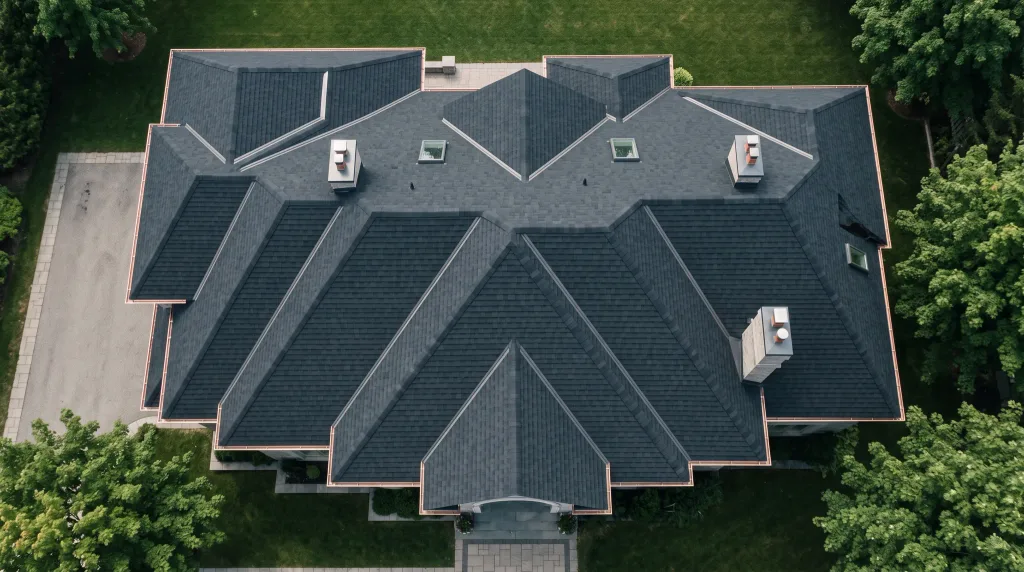
We use drones where physical access adds real risk without adding information, such as steep heritage rooflines or tall commercial buildings, and pair the flight with a close-up check of anything it flags. Aerial imagery cannot find soft decking, a loose flashing, or membrane saturation, so it supplements a hands-on inspection rather than replacing one.
How soon do I get the report?
Within 24 hours of the inspection. It includes photographs, noted deficiencies, cause analysis where relevant, and prioritized recommendations, in a format suitable for a real estate transaction, an insurance renewal, or a reserve fund file.
How often should a roof be inspected?
Every two to three years for most residential properties, and annually for commercial and multi-unit buildings feeding reserve fund planning. Lake-exposed properties benefit from the shorter interval because flashing metal corrodes faster there. Any roof should also be checked after a significant wind or ice event.
Will the report tell me whether I need a full replacement?
It will tell you what has failed, what has not, and how long the roof has left, with the reasoning shown so you can judge it. Where replacement genuinely is the answer the report shows why in photographs. Where a targeted repair will carry the roof several more years, it says that instead, which happens more often than most owners expect.
Do you inspect commercial roofs?
Yes. A commercial roof inspection covers the membrane field, lap seams, drains, parapet flashing and rooftop equipment curbs, with core samples where saturation is suspected. Property managers and condo boards usually put the building on an annual program, and the report is formatted for a reserve fund file.
Need a report that holds up with a lender or insurer?