
Roof Moisture Detection Toronto
The damage is already happening.
Moisture in a roof assembly causes invisible damage long before interior staining appears. We quantify moisture content across the full surface without cutting open the roof.
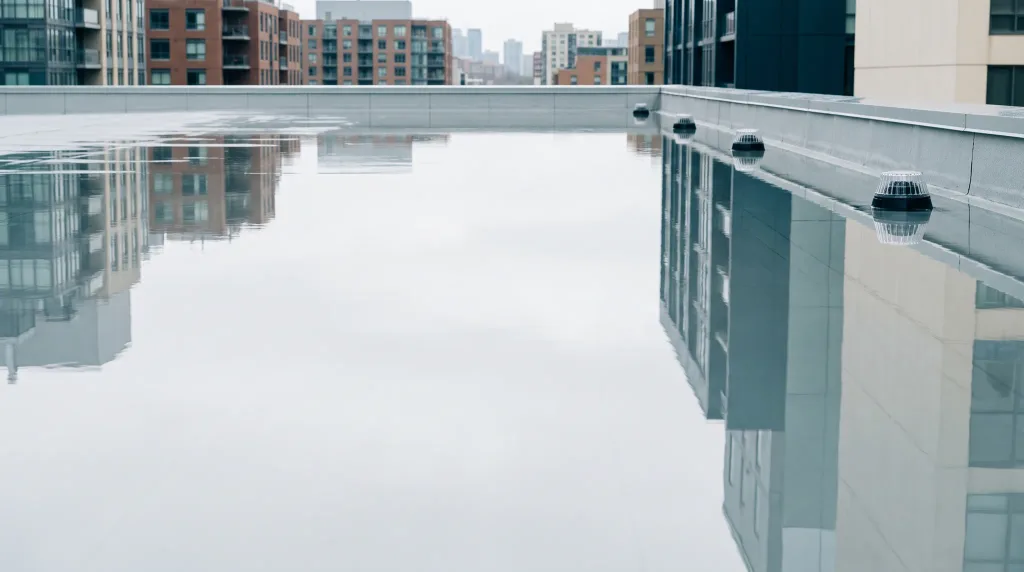
Moisture detection methods we apply to your roof.
Non-destructive testing that quantifies moisture content without cutting open the roof assembly.
Nuclear Moisture Scanning
Capacitance Probe Testing
Electrical Resistance Testing
Core Sample Analysis
Insulation Moisture Quantification
Moisture Baseline Surveys
Nuclear Moisture Scanning
Gold standard method
Nuclear scanners detect hydrogen atoms in moisture with extreme sensitivity, the most accurate non-destructive method for flat roof wet insulation mapping.
Capacitance Probe Testing
Membrane moisture mapping
Capacitance meters measure moisture content at the membrane surface and substrate interface, accurate for detecting moisture migration paths.
Electrical Resistance Testing
Localized wet area detection
Impedance meters identify elevated moisture at specific points, useful for verifying visual or thermal findings with a calibrated measurement.
Core Sample Analysis
Ground-truth verification
When non-destructive testing suggests moisture, targeted core samples verify the finding and reveal the depth and extent of saturation.
Insulation Moisture Quantification
Wet insulation mapping
We quantify what percentage of insulation is compromised, the critical metric for the repair vs. replace decision on commercial flat roofs.
Moisture Baseline Surveys
Pre- and post-installation
Pre-roofing moisture surveys establish a baseline for warranty disputes. Post-roofing surveys confirm no moisture was trapped under new membrane.
Flat roof showing signs of moisture? A detection survey tells you exactly how much, and where.
Why Blue Knight moisture surveys tell you what you actually need to know.
Nuclear scanning capability
Multiple testing methods
Non-destructive methodology
Repair vs. replace decision support
Written survey report
Nuclear scanning capability
Nuclear moisture scanners are the most sensitive non-destructive method for flat roof insulation assessment.
Multiple testing methods
We select the appropriate test method for the roof type, membrane system, and moisture presentation.
Non-destructive methodology
We quantify moisture content across the full roof surface without cutting into the membrane or insulation.
Repair vs. replace decision support
The percentage of wet insulation is the key metric for deciding whether targeted repair or full replacement is the better investment.
Written survey report
Every moisture survey delivers a scaled moisture map, wet area percentages, and recommended actions.
“A wet roof that looks dry from above can have years of deck damage hidden underneath. Testing tells you what's actually there.”
“A wet roof that looks dry from above can have years of deck damage hidden underneath. Testing tells you what's actually there.”
Rated 5 out of 5Blue Knight was, by far, the best. Responsive, ethical, totally professional — and their crew went above and beyond at no extra charge.
Rated 5 out of 5They installed a full new roof in one day. The crew worked around the house without us hardly knowing they were there.
Rated 5 out of 5I emailed at 4 a.m. and spoke with someone that same day. Estimate and completed work all within one day. Pricing was fair, work was excellent.
I emailed at 4 a.m. and spoke with someone that same day. Estimate and completed work all within one day. Pricing was fair, work was excellent.
Blue Knight was, by far, the best. Responsive, ethical, totally professional — and their crew went above and beyond at no extra charge.
They installed a full new roof in one day. The crew worked around the house without us hardly knowing they were there.
Luciano did not try to sell me a new roof. Appreciated the honesty — he showed up when he said he would.
We had a leak diagnosed by two other contractors who could not find the source. Blue Knight found it on the first visit and fixed it the same week.
Flat roof replacement on a commercial unit. Clean, fast, no surprises on the invoice. The crew left the site cleaner than they found it.
Called after a storm damaged our roof. Someone was on site within hours, tarped everything, and had us fully repaired before the next rain.
Had a slow basement leak for years. Every other company just caulked it. Blue Knight found the actual source and did a proper waterproofing job. No issues since.
Our neighbours recommended them for a valley repair. Small job, but they treated it like it mattered — showed up on time, matched the shingles perfectly, and charged exactly what they quoted.
Our Work.
Rooftops across the GTA.
From downtown Toronto to the 905 and beyond, one crew, one warranty, twenty-five years of GTA rooflines.
Service availability may vary. Call (647) 383-8664 to confirm coverage for your area.
Rooftops across the GTA.
From downtown Toronto to the 905 and beyond, one crew, one warranty, twenty-five years of GTA rooflines.
Service availability may vary. Call (647) 383-8664 to confirm coverage for your area.
Moisture detection questions.
A full nuclear moisture survey on a commercial flat roof under 10,000 sq ft: $800-$1,500. Capacitance probe grid survey of similar area: $600-$1,200. Core sample verification (per sample): $200-$400. The survey cost is typically 5-10% of the repair cost decision it informs.
Nuclear moisture scanners detect the presence of hydrogen atoms through a sealed radiation source and detector. The sealed source emits low-level radiation that is safe for operators and building occupants. The technique is Transport Canada-regulated and widely used in commercial roofing assessment. It is the most sensitive and accurate non-destructive moisture measurement method for flat roof insulation.
Signs of probable hidden moisture: unexplained interior staining that has appeared gradually; increased heating costs in a building with a flat roof; visible membrane blistering; visible discolouration in gravel-surfaced roofs. The only reliable way to confirm and quantify is testing, visual signs are often absent until moisture saturation is extensive.
In practice, saturated insulation in a flat roof assembly does not dry effectively in situ, the membrane prevents evaporation. Once insulation is saturated, replacement of the affected zone is almost always required. The argument for testing is early detection when the wet area is small and repair is targeted.
A common industry guideline: under 20% wet area, targeted replacement of wet sections; 20-40%, phased section replacement; over 40%, full replacement typically produces better long-term value. We apply this analysis in our moisture detection reports and provide a clear recommendation based on the survey findings.
What GTA Property Owners Ask About Roof Moisture Detection.
From nuclear scanning to repair decisions, answered by 25-year GTA roofing specialists.
The primary methods: (1) Nuclear moisture scanning, measures hydrogen atom concentration, the most sensitive non-destructive method; (2) Capacitance probing, measures dielectric constant changes caused by moisture; (3) Electrical impedance testing, measures resistance changes in moist materials; (4) Thermal imaging, detects temperature differentials caused by wet insulation; (5) Core sampling, physical verification of moisture at depth. We select the method based on the roof type, membrane system, and the question being answered.
Nuclear scanning is generally considered the most sensitive and accurate non-destructive method for detecting moisture in flat roof insulation. It detects hydrogen directly rather than inferring moisture from indirect properties like temperature or dielectric constant. For large commercial roofs, we typically combine thermal imaging (rapid survey) with nuclear scanning (verification of identified zones).
A capacitance probe measures the dielectric constant of the material it contacts, a property that changes significantly in the presence of moisture. Probes are placed at regular grid intervals across the roof surface (typically on a 4-6 foot grid on commercial roofs), and the readings are mapped to produce a moisture content distribution across the surface. Capacitance testing is faster than nuclear scanning and is well-suited to identifying moisture migration patterns.
A nuclear moisture survey of a commercial flat roof under 10,000 sq ft: $800-$1,500 depending on access and grid density. Larger roofs are quoted on scope. The survey typically costs less than one section of membrane replacement, and determines whether that replacement is actually needed and where.
- What methods are used for roof moisture detection in Toronto?
- The primary methods: (1) Nuclear moisture scanning, measures hydrogen atom concentration, the most sensitive non-destructive method; (2) Capacitance probing, measures dielectric constant changes caused by moisture; (3) Electrical impedance testing, measures resistance changes in moist materials; (4) Thermal imaging, detects temperature differentials caused by wet insulation; (5) Core sampling, physical verification of moisture at depth. We select the method based on the roof type, membrane system, and the question being answered.
- What is the most accurate moisture detection method for flat roofs?
- Nuclear scanning is generally considered the most sensitive and accurate non-destructive method for detecting moisture in flat roof insulation. It detects hydrogen directly rather than inferring moisture from indirect properties like temperature or dielectric constant. For large commercial roofs, we typically combine thermal imaging (rapid survey) with nuclear scanning (verification of identified zones).
- What is a capacitance probe and how is it used for roof moisture testing?
- A capacitance probe measures the dielectric constant of the material it contacts, a property that changes significantly in the presence of moisture. Probes are placed at regular grid intervals across the roof surface (typically on a 4-6 foot grid on commercial roofs), and the readings are mapped to produce a moisture content distribution across the surface. Capacitance testing is faster than nuclear scanning and is well-suited to identifying moisture migration patterns.
- How much does nuclear moisture scanning cost in Toronto?
- A nuclear moisture survey of a commercial flat roof under 10,000 sq ft: $800-$1,500 depending on access and grid density. Larger roofs are quoted on scope. The survey typically costs less than one section of membrane replacement, and determines whether that replacement is actually needed and where.
- How much does roof moisture detection compare to just replacing the roof?
- A moisture detection survey for a 10,000 sq ft commercial roof costs $800-$1,500. Full roof replacement of the same area costs $80,000-$200,000. If the survey shows only 15% wet area, targeted replacement costs $12,000-$30,000, a decision worth more than 20 times the survey cost. Even if full replacement is indicated, knowing the extent precisely reduces the risk of scope gaps that lead to callbacks.
- Is roof moisture detection included in a standard roof inspection?
- Standard visual roof inspections do not include moisture testing, they assess visible surface conditions only. Moisture testing is a separate scope that requires specialized equipment. We include moisture testing when: the roof is over 15 years old, interior staining has been reported, membrane blistering is visible, or the inspection is being conducted for insurance underwriting or reserve fund purposes.
- Why is moisture detection important for Toronto flat roofs?
- Toronto flat roofs face multiple moisture risks: freeze-thaw cycling that stresses membrane seams and penetrations, heavy spring snowmelt that saturates drainage systems, and the buried insulation systems common on GTA commercial buildings that can accumulate moisture for years without visible surface symptoms. Unlike sloped roofs where water runs off quickly, flat roof moisture accumulates in the insulation and can go undetected for years while causing progressive deck and structural damage.
- How often should a commercial flat roof be tested for moisture in Toronto?
- A baseline moisture survey at the time of a new roof installation, then every 5 years for roofs under 15 years old, and every 2-3 years for roofs over 15 years old. Annual testing for roofs that have shown moisture infiltration in prior surveys, to track whether moisture is expanding.
- Can moisture under a flat roof cause structural damage in Toronto?
- Yes. Long-term moisture saturation in flat roof insulation and decking causes progressive deterioration of the deck material, corrosion of steel deck fasteners and structural connections, potential mould growth in accessible attic spaces, and eventual structural failure if moisture reaches load-bearing connections. Toronto's freeze-thaw cycling accelerates the damage, water in saturated insulation expands when it freezes, enlarging cracks and accelerating deterioration.
- Is moisture in a flat roof covered by insurance in Ontario?
- Damage from a sudden, insured event, a storm that forced water under a failed seam, is typically covered. Gradual moisture accumulation from maintenance-deferred drainage failures or aging membranes is a maintenance exclusion. The key is establishing whether the moisture infiltration is attributable to a specific event. A moisture detection report conducted promptly after a suspect event provides the documentation basis for an insurance claim.
- What does a moisture detection report tell me?
- The report quantifies: (1) the location and extent of moisture infiltration mapped on a scaled roof plan; (2) the percentage of the total roof area that is wet; (3) the depth of moisture penetration; (4) an assessment of whether moisture has reached the structural deck; and (5) recommended repair approach based on the moisture findings, targeted section replacement, phased repair, or full replacement.
- How do I interpret a nuclear moisture scan report?
- The key metric is the wet percentage, what proportion of the insulation field has elevated moisture content. Under 20% wet: targeted repair of the wet zones is typically the right decision. 20-40% wet: phased repair or full section replacement. Over 40% wet: full replacement often produces better long-term value. The report should also identify whether moisture is concentrated (suggesting a specific entry point) or diffuse (suggesting widespread membrane degradation).
- Can I use a moisture detection report for a property purchase in Toronto?
- Yes. A pre-purchase moisture detection survey on a commercial building or condo with flat roofing provides: (1) documentation of the actual condition of the roof insulation; (2) a repair cost estimate based on wet area; (3) a negotiating tool if significant moisture is found; (4) liability protection, demonstrating due diligence in investigating the condition of a major building component.
- How does moisture detection change the roof repair decision?
- Without moisture data, repair decisions are based on visual surface condition, which often underestimates or overestimates the actual scope of moisture damage. With moisture data, the repair scope is precisely defined: replace the confirmed wet zones, not a rough estimate. This leads to more accurate repair costs, fewer callbacks from missed wet areas, and elimination of unnecessary replacement of dry insulation.
- What happens if moisture in a flat roof is not detected and repaired?
- Progressive deterioration: moisture expands the wet insulation field each season through capillary action; freeze-thaw cycling mechanically damages saturated insulation and deck; the wet area doubles roughly every 3-5 years in a poorly managed system; structural deck deterioration begins at year 5-10 of continuous saturation; and the eventual repair scope is significantly larger than if the moisture had been detected and repaired at the 20% wet stage.
- Should I repair my flat roof or replace it based on moisture detection results?
- Our standard decision framework: under 20% wet area, repair the wet zones; 20-40% wet, evaluate whether repair or section replacement delivers better long-term value based on remaining membrane life; over 40% wet, full replacement is almost always more cost-effective. We apply this framework in every moisture detection report and provide a clear recommendation with cost comparison.
More ways Blue Knight can help.
Thermal Imaging
Learn more InspectionsDrone Inspections
Learn more InspectionsForensic Investigations
Learn moreReady to schedule your estimate?
We come to you, assess the roof, and give you a written quote. You are not obliged to proceed. Most estimates completed same week.