
Parking Deck Waterproofing Toronto
Parking deck waterproofing that carries traffic.
Parking decks carry vehicular loads, de-icing salts, and standing water simultaneously. We specify and install the right membrane system for each.
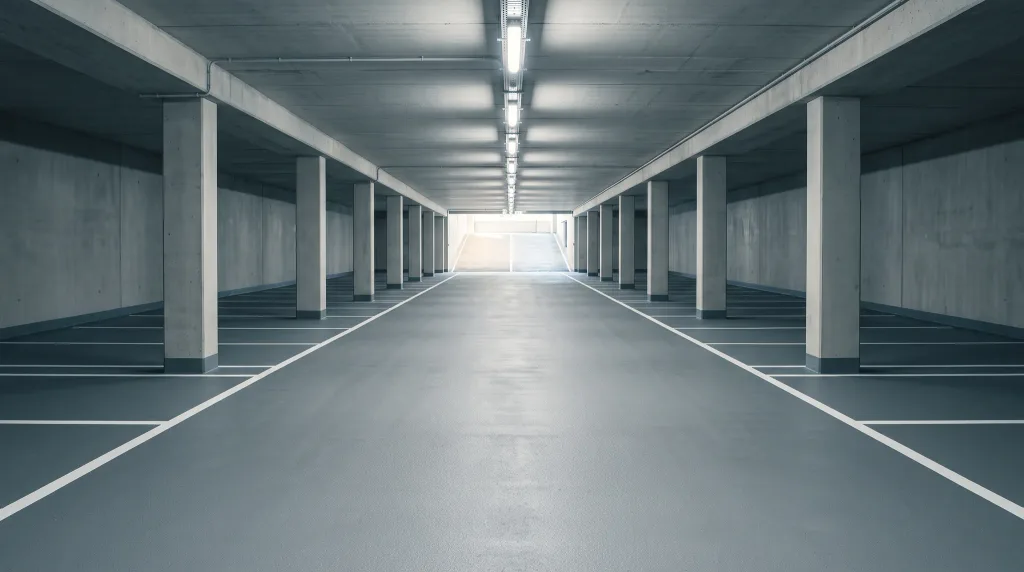
Parking deck failures we assess and repair.
Vehicular traffic, de-icing salts, and Toronto winters accelerate every vulnerability in a parking structure.
Vehicular Membrane Failure
Expansion Joint Failure
Drain Trench Failure
Concrete Spalling
Through-Slab Leaks
Edge & Coping Failure
Vehicular Membrane Failure
Traffic-bearing systems
Heavy-duty deck coatings crack under thermal cycling and vehicular loads. Water and salt reach the slab before visible damage appears.
Expansion Joint Failure
First point of water entry
Joints between deck sections move with every temperature cycle. Cracked sealant lets de-icing brine directly to the structure below.
Drain Trench Failure
Standing water & backfall
Failed trench drains create ponding across the deck, accelerating membrane failure and freeze-thaw damage.
Concrete Spalling
Rebar corrosion damage
De-icing salt-laden water reaching steel reinforcement causes corrosion and delamination, a structural concern.
Through-Slab Leaks
Below-deck damage
Water reaching the ceiling of occupied space below requires immediate membrane restoration.
Edge & Coping Failure
Perimeter water entry
Water entering at deck edges and copings bypasses the membrane entirely. Edge details must be watertight for any system to perform.
Parking deck leaking into occupied space below? We assess and specify same-day across the GTA.
Why Blue Knight specifies right for parking deck environments.
Vehicular-rated membrane systems
Expansion joint expertise
Commercial & condo experience
Drainage system restoration
Concrete substrate repair
Vehicular-rated membrane systems
Parking decks require heavy-duty membranes rated for vehicular loads, de-icing chemicals, and thermal cycling.
Expansion joint expertise
Joints fail before the membrane. We specify systems rated for the movement and traffic load.
Commercial & condo experience
We produce condition assessments, phased work plans, and condo corporation documentation for every project.
Drainage system restoration
We repair and replace trench drain systems, catch basins, and the membrane perimeter at every drain.
Concrete substrate repair
No membrane lasts on failing concrete. We assess and repair the substrate before any waterproofing is applied.
“A parking deck membrane failure is always a structural problem waiting to happen. De-icing salts and water reach the rebar long before anyone notices a stain below.”
“A parking deck membrane failure is always a structural problem waiting to happen. De-icing salts and water reach the rebar long before anyone notices a stain below.”
Rated 5 out of 5Blue Knight was, by far, the best. Responsive, ethical, totally professional — and their crew went above and beyond at no extra charge.
Rated 5 out of 5They installed a full new roof in one day. The crew worked around the house without us hardly knowing they were there.
Rated 5 out of 5I emailed at 4 a.m. and spoke with someone that same day. Estimate and completed work all within one day. Pricing was fair, work was excellent.
I emailed at 4 a.m. and spoke with someone that same day. Estimate and completed work all within one day. Pricing was fair, work was excellent.
Blue Knight was, by far, the best. Responsive, ethical, totally professional — and their crew went above and beyond at no extra charge.
They installed a full new roof in one day. The crew worked around the house without us hardly knowing they were there.
Luciano did not try to sell me a new roof. Appreciated the honesty — he showed up when he said he would.
We had a leak diagnosed by two other contractors who could not find the source. Blue Knight found it on the first visit and fixed it the same week.
Flat roof replacement on a commercial unit. Clean, fast, no surprises on the invoice. The crew left the site cleaner than they found it.
Called after a storm damaged our roof. Someone was on site within hours, tarped everything, and had us fully repaired before the next rain.
Had a slow basement leak for years. Every other company just caulked it. Blue Knight found the actual source and did a proper waterproofing job. No issues since.
Our neighbours recommended them for a valley repair. Small job, but they treated it like it mattered — showed up on time, matched the shingles perfectly, and charged exactly what they quoted.
Our Work.
Rooftops across the GTA.
From downtown Toronto to the 905 and beyond, one crew, one warranty, twenty-five years of GTA rooflines.
Service availability may vary. Call (647) 383-8664 to confirm coverage for your area.
Rooftops across the GTA.
From downtown Toronto to the 905 and beyond, one crew, one warranty, twenty-five years of GTA rooflines.
Service availability may vary. Call (647) 383-8664 to confirm coverage for your area.
Parking deck waterproofing questions.
$15-$45 per sq ft installed depending on the system, substrate condition, and concrete repair scope. A 5,000 sq ft surface deck with moderate concrete repair: $75,000-$150,000. A large underground parkade with full membrane replacement, joint restoration, and drain work can reach $500,000+. We provide detailed written scope and fixed-price contracts after condition assessment.
Vehicular traffic membrane systems properly installed and maintained: 10-20 years. The primary lifespan factors are concrete substrate quality, completeness of expansion joint sealing, drainage maintenance, and traffic volume. De-icing salt application dramatically accelerates membrane degradation.
New parking structures require waterproof deck membranes under OBC as part of the building envelope. For existing structures, there is no specific OBC mandate to retrofit waterproofing, but ongoing water and salt infiltration creates structural liability as rebar corrosion compromises the slab's load capacity.
Yes, and we recommend it for occupied buildings. We phase work in sections, typically working one bay at a time and maintaining vehicular access to the majority of the deck throughout. Phased work costs slightly more per sq ft due to mobilization but avoids complete parking loss.
Vehicular traffic membranes are significantly more robust than balcony coatings, rated for wheel loads, abrasion, and de-icing chemical exposure that balcony coatings are not designed for. Using a balcony-rated coating on a vehicular deck produces accelerated failure, typically within 3-5 years.
What Property Managers Ask About Parking Deck Waterproofing.
From vehicular membranes to condo corporation documentation, answered by commercial GTA waterproofing specialists.
$15-$45 per sq ft installed for the membrane system alone. Concrete spall repair and crack injection adds $5-$20 per sq ft depending on severity. A 5,000 sq ft deck with moderate repairs: $75,000-$150,000. A large parkade with full replacement: $300,000-$500,000+. We provide a written condition assessment with quantified repair scope and a fixed-price contract before any work begins.
Yes. Parking deck membrane replacement is a common element capital repair eligible for reserve fund expenditure under the Ontario Condominium Act. It should appear in the reserve fund study as a capital replacement item with a scheduled lifespan. We provide condition assessments and cost projections suitable for reserve fund studies and board budget planning.
Deferred waterproofing accelerates concrete spalling and rebar corrosion, each stage of deterioration increases repair cost non-linearly. A membrane that costs $25/sq ft to replace when the concrete is sound may cost $60-$100/sq ft when the concrete requires extensive spall repair. Structural slab replacement is typically $150-$300/sq ft. Waterproofing is always cheaper than the structural alternative.
The dominant systems are: (1) hot-applied rubberized asphalt, the most durable, used on underground parkades and high-traffic decks; (2) polyurethane traffic coatings, for lower-traffic surface decks; (3) PUMA and PMMA reactive resins, fast-cure systems suitable for phased work in occupied structures. The right system depends on traffic volume, exposure conditions, and the need to maintain access during installation.
- How much does parking deck waterproofing cost in Toronto?
- $15-$45 per sq ft installed for the membrane system alone. Concrete spall repair and crack injection adds $5-$20 per sq ft depending on severity. A 5,000 sq ft deck with moderate repairs: $75,000-$150,000. A large parkade with full replacement: $300,000-$500,000+. We provide a written condition assessment with quantified repair scope and a fixed-price contract before any work begins.
- Can parking deck waterproofing be funded through a condo reserve fund?
- Yes. Parking deck membrane replacement is a common element capital repair eligible for reserve fund expenditure under the Ontario Condominium Act. It should appear in the reserve fund study as a capital replacement item with a scheduled lifespan. We provide condition assessments and cost projections suitable for reserve fund studies and board budget planning.
- What are the costs of not waterproofing a failing parking deck?
- Deferred waterproofing accelerates concrete spalling and rebar corrosion, each stage of deterioration increases repair cost non-linearly. A membrane that costs $25/sq ft to replace when the concrete is sound may cost $60-$100/sq ft when the concrete requires extensive spall repair. Structural slab replacement is typically $150-$300/sq ft. Waterproofing is always cheaper than the structural alternative.
- What types of parking deck membranes are used in Toronto?
- The dominant systems are: (1) hot-applied rubberized asphalt, the most durable, used on underground parkades and high-traffic decks; (2) polyurethane traffic coatings, for lower-traffic surface decks; (3) PUMA and PMMA reactive resins, fast-cure systems suitable for phased work in occupied structures. The right system depends on traffic volume, exposure conditions, and the need to maintain access during installation.
- How is a vehicular parking deck membrane different from a roofing membrane?
- Parking deck membranes must withstand point loads from vehicle tires, abrasion from tire wear and de-icing grit, and chemical attack from de-icing salts. Roofing membranes are not designed for any of these conditions. Installing a roofing-grade membrane on a vehicular deck produces failure within a few seasons. We specify only membranes tested to vehicular traffic standards.
- Can a parking deck membrane be repaired rather than replaced?
- Isolated failures, cracks, punctures, delaminated sections under 15-20% of total area, can be cut out and patched with compatible material. Above that threshold, the surrounding membrane is typically at end of life regardless of its current appearance, and full replacement produces better long-term value. We assess the percentage of failure across the deck surface in our condition assessment.
- What is a parking deck traffic coating and how is it maintained?
- A traffic coating is a liquid-applied elastomeric membrane, typically polyurethane, applied to the concrete deck surface. Maintenance involves sealing cracks as they appear annually, re-sealing expansion joints every 7-10 years, and applying a renewal coat over worn areas before the base coat is penetrated. A traffic coating maintained proactively can last 15-20 years; one left to fail requires full replacement at year 8-10.
- Why do parking deck expansion joints fail faster than the membrane?
- Expansion joints must absorb all the thermal movement of large concrete deck sections, in Toronto's climate, that can be 10-15mm of movement per year per joint. The sealant is under constant stress from vehicle loads crossing it, UV degradation, and thermal cycling. Most sealants in parking deck joints last 8-15 years before losing elasticity. When a joint cracks, de-icing brine runs directly through it to the structure below.
- What type of expansion joint system is used in parking decks?
- The two main systems are: (1) sealant-based joints, backer rod plus elastomeric sealant, appropriate for most residential parking decks; (2) compression seal systems, pre-formed elastomeric seals mechanically installed in the joint groove, rated for vehicular loads and longer service life, used in high-traffic commercial parkades. We specify the joint system based on expected movement, traffic load, and service life requirements.
- Can parking deck expansion joints be sealed without replacing the membrane?
- Yes. Expansion joint re-sealing is a standalone maintenance operation that does not require membrane replacement. If the membrane adjacent to the joint is sound, we remove the old sealant, clean the joint, install new backer rod, and apply new elastomeric sealant. This maintenance item is typically 10-20% of the cost of full membrane replacement and extends the useful life of both the joint and the surrounding membrane significantly.
- What is concrete spalling in a parking deck and why does it happen?
- Spalling is the delamination and flaking of concrete from the slab surface, typically driven by steel reinforcement corrosion. When de-icing salt-laden water penetrates the membrane and reaches the rebar, it causes the steel to corrode and expand. The expanding corrosion products crack the concrete cover above the rebar, causing chunks to fall. Each spalled zone exposes more rebar to chloride attack, accelerating the next cycle.
- How do you repair concrete spalling in a Toronto parking deck?
- Spall repair involves removing all delaminated and carbonated concrete back to sound material (typically 75mm minimum past the rebar), cleaning and priming the exposed rebar, applying a corrosion inhibitor, and placing polymer-modified concrete repair mortar in lifts. The repair is overlaid with membrane before the deck is returned to service. Proper spall repair is a prerequisite for any waterproofing installation.
- How do I know if my parking deck has structural problems beyond waterproofing?
- Signs requiring structural engineer involvement: horizontal cracking in slab beams or columns, visible deflection (sagging) of the deck slab, wide crack patterns inconsistent with thermal movement, or multiple closely-spaced spall zones indicating widespread rebar corrosion. We flag any structural concern observed during assessment and can coordinate with a structural engineer before specifying waterproofing.
- How long does parking deck waterproofing take in Toronto?
- A 5,000 sq ft surface deck with moderate concrete repair: 2-4 weeks including concrete curing time before membrane installation. A large underground parkade done in phases: 6-12 weeks depending on scope and access constraints. We provide a detailed project schedule with access interruption windows before mobilizing.
- Can parking deck waterproofing work be done in winter in Toronto?
- Most liquid-applied membranes require above +5°C application temperature and a dry, frost-free substrate. For most Toronto projects, we schedule waterproofing April through October and perform only concrete repair and assessment work in winter months. Fast-cure PMMA systems with cold-temperature specifications can be used under heated tent enclosures for emergency situations.
- What happens after parking deck waterproofing, how do I maintain it?
- Annual inspection: check joint sealants, drain conditions, and the membrane surface for cracks or worn areas. Reseal any crack over 1mm width before the next winter. Re-seal expansion joints every 7-10 years regardless of visible condition. Apply renewal coat over worn traffic zones before the base coat is fully depleted. We provide a written maintenance protocol with every installation.
More ways Blue Knight can help.
Basement & Below-Grade
Learn more WaterproofingBalcony & Terrace
Learn more WaterproofingCrack Injection
Learn moreReady to schedule your estimate?
We come to you, assess the roof, and give you a written quote. You are not obliged to proceed. Most estimates completed same week.