
Roof Flashing Repair Toronto
Most leaks start at the joints, not the surface.
Flashing failures cause the majority of roof leaks. We repair chimney flashing, step flashing, valley metal, pipe boots, and flat roof drains.
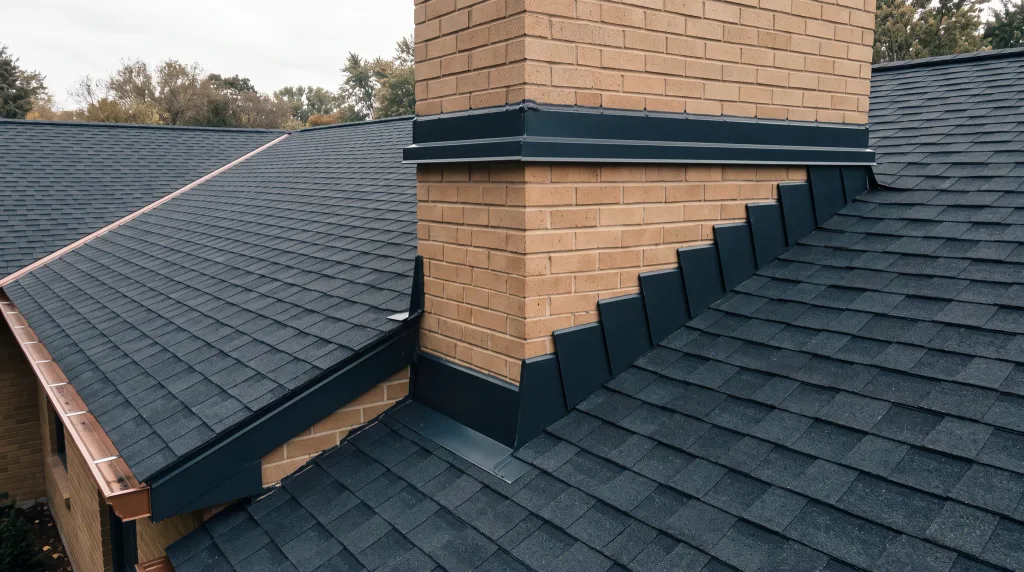
Flashing and drain failures we trace and fix.
Most roof leaks start at a joint, not the surface. We find the specific junction that failed.
Chimney Flashing & Repair
Valley Metal & W-Valley
Pipe Boots & Penetrations
Step Flashing at Walls
Flat Roof Drains & Strainers
Parapet & Edge Flashings
Chimney Flashing & Repair
Flashing, crowns, mortar
The most common flashing leak source in Toronto. Step flashing and counter flashing both fail, usually at the caulk joint between them.
Valley Metal & W-Valley
High-water-flow zones
Valleys shed more water than any other roof area. Corroded or displaced valley metal is a direct leak path into the deck.
Pipe Boots & Penetrations
Vent stacks, HVAC, skylights
Neoprene boots crack within 8-12 years. HVAC curb flashing fails at the caulk line. Every penetration is a potential leak.
Step Flashing at Walls
Dormer & addition junctions
Where a roof meets a vertical wall, step and counter flashing must work together. This joint fails frequently on Toronto's older additions.
Flat Roof Drains & Strainers
Drainage system repair
Blocked or deteriorated drains cause ponding that kills membranes. We clear drains, replace drain bodies, and repair the membrane perimeter.
Parapet & Edge Flashings
Flat roof perimeter
Where the membrane terminates at a parapet, coping and through-wall flashings must be watertight. Failures here often cause interior wall leaks.
The leak is almost always at a joint. We find which one and fix it permanently.
Why Blue Knight finds the joint every other roofer misses.
Flashing is our specialty
All metal types
Flat roof drainage expertise
Toronto's older housing stock
Written report on every job
Flashing is our specialty
Most roofers rush through flashing. We slow down at every junction, statistically, that's where the leak is.
All metal types
We work with every flashing material in the GTA, including copper and lead on Toronto's older masonry chimneys.
Flat roof drainage expertise
We inspect and repair drain bodies, strainers, and the membrane perimeter around every drain.
Toronto's older housing stock
Homes built before 1985 often have undersized step flashing. We've re-flashed hundreds to code.
Written report on every job
We photograph every point before and after, a record for the next owner or the next roofer.
“Flashing repair done right lasts 20 years. Done wrong, it leaks the next winter. We've fixed a lot of other people's wrong repairs.”
“Flashing repair done right lasts 20 years. Done wrong, it leaks the next winter. We've fixed a lot of other people's wrong repairs.”
Rated 5 out of 5Blue Knight was, by far, the best. Responsive, ethical, totally professional — and their crew went above and beyond at no extra charge.
Rated 5 out of 5They installed a full new roof in one day. The crew worked around the house without us hardly knowing they were there.
Rated 5 out of 5I emailed at 4 a.m. and spoke with someone that same day. Estimate and completed work all within one day. Pricing was fair, work was excellent.
I emailed at 4 a.m. and spoke with someone that same day. Estimate and completed work all within one day. Pricing was fair, work was excellent.
Blue Knight was, by far, the best. Responsive, ethical, totally professional — and their crew went above and beyond at no extra charge.
They installed a full new roof in one day. The crew worked around the house without us hardly knowing they were there.
Luciano did not try to sell me a new roof. Appreciated the honesty — he showed up when he said he would.
We had a leak diagnosed by two other contractors who could not find the source. Blue Knight found it on the first visit and fixed it the same week.
Flat roof replacement on a commercial unit. Clean, fast, no surprises on the invoice. The crew left the site cleaner than they found it.
Called after a storm damaged our roof. Someone was on site within hours, tarped everything, and had us fully repaired before the next rain.
Had a slow basement leak for years. Every other company just caulked it. Blue Knight found the actual source and did a proper waterproofing job. No issues since.
Our neighbours recommended them for a valley repair. Small job, but they treated it like it mattered — showed up on time, matched the shingles perfectly, and charged exactly what they quoted.
Our Work.
Rooftops across the GTA.
From downtown Toronto to the 905 and beyond, one crew, one warranty, twenty-five years of GTA rooflines.
Service availability may vary. Call (647) 383-8664 to confirm coverage for your area.
Rooftops across the GTA.
From downtown Toronto to the 905 and beyond, one crew, one warranty, twenty-five years of GTA rooflines.
Service availability may vary. Call (647) 383-8664 to confirm coverage for your area.
Flashing & drain questions.
Chimney flashing repair in Toronto typically runs $400-$1,400. A simple re-caulk of the counter flashing joint is at the low end ($400-$600). Full step and counter flashing replacement, stripping old flashing, installing new aluminum step flashing and counter flashing embedded in new mortar joints, runs $800-$1,400 depending on chimney perimeter size.
Step flashing is the L-shaped metal pieces woven into the shingle courses along a vertical wall or chimney, they sit against the wall, overlapping upward. Counter flashing is the piece that overlaps the step flashing from above, typically embedded in the mortar joint of a masonry chimney. Both must work together; a failure in either allows water behind the shingle course and into the wall.
Properly installed aluminum or galvanized steel flashing can last 20-30 years, often outlasting the shingles around it. The limiting factor in Toronto is the caulk joint at the counter flashing-to-masonry interface, which requires re-caulking every 5-8 years under Toronto's freeze-thaw conditions. Copper flashing lasts 60+ years and is worth the premium for chimneys on older Toronto masonry homes.
Yes. A blocked drain on a flat roof allows water to pond, which adds approximately 5 lbs per square foot per inch of standing water. A large ponding zone of 400 sq ft with 3 inches of water adds over 1,500 lbs of undesigned load. More immediately, the backed-up water accelerates membrane failure at seams and penetrations, turning a drain cleaning into a membrane repair if left unaddressed.
Flashing failure from storm damage, wind-displaced chimney caps, flashing torn by falling ice or branches, is typically covered. Gradual deterioration of caulk or aged flashing metal is considered maintenance and is excluded. If a storm event caused or worsened a flashing failure, document the storm date and the before/after condition. We write inspection reports that support insurance submissions where the cause is a covered event.
Both, at the roof line. We rebuild step and counter flashing, repoint the mortar joints where the flashing is let into the brick, and reseal or recap a cracked chimney crown. Where a chimney needs masonry rebuilt above the roof, the written report says so and we scope it before starting.
What GTA Homeowners Ask About Flashing & Drains.
From chimney flashing failures to blocked flat roof drains, answered by 25-year GTA specialists.
The most common reason is that only the caulk was replaced without addressing the underlying step and counter flashing installation. Caulk is a sealant, not a flashing system, it fails in 3-5 years under Toronto's freeze-thaw conditions if it's doing structural work it wasn't designed for. A proper chimney flashing repair embeds new counter flashing into the mortar joint and installs correctly lapped step flashing behind each shingle course. Caulk is only the final weather seal on top of that system.
Interior staining near the chimney that appears after rain points to flashing failure. Staining that has a white mineral deposit (efflorescence) pattern on the chimney interior wall can indicate mortar or brick deterioration allowing water migration through the masonry itself. A roofing inspection assesses the flashing; a masonry assessment checks the chimney crown, joints, and cap. We assess both on a chimney leak call.
Properly installed aluminum or galvanized step and counter flashing: 20-30 years. The caulk at the counter flashing-to-brick interface requires re-caulking every 5-8 years, this is a maintenance item, not a failure. Copper flashing lasts the life of the chimney (60+ years) and is worth the cost on older Toronto masonry homes in the Annex, Rosedale, or Forest Hill where the chimney is original masonry and re-flashing is a one-time proposition.
Organic debris, leaves, seed pods, moss, and HVAC condensate, accumulates in flat roof drains on Toronto properties year-round. The combination of Toronto's mature urban tree canopy and the frequency of wind events means drains need clearing at minimum twice a year. The strainer (drain cover) should be checked monthly during fall. A drain that blocks repeatedly despite cleaning may have a subsidence issue, the roof has settled away from the drain collar, creating a low spot that collects debris.
- Why does my chimney flashing keep leaking even after it was repaired?
- The most common reason is that only the caulk was replaced without addressing the underlying step and counter flashing installation. Caulk is a sealant, not a flashing system, it fails in 3-5 years under Toronto's freeze-thaw conditions if it's doing structural work it wasn't designed for. A proper chimney flashing repair embeds new counter flashing into the mortar joint and installs correctly lapped step flashing behind each shingle course. Caulk is only the final weather seal on top of that system.
- How do I know if my chimney flashing is leaking or the mortar is failing?
- Interior staining near the chimney that appears after rain points to flashing failure. Staining that has a white mineral deposit (efflorescence) pattern on the chimney interior wall can indicate mortar or brick deterioration allowing water migration through the masonry itself. A roofing inspection assesses the flashing; a masonry assessment checks the chimney crown, joints, and cap. We assess both on a chimney leak call.
- How long does chimney flashing last on a Toronto home?
- Properly installed aluminum or galvanized step and counter flashing: 20-30 years. The caulk at the counter flashing-to-brick interface requires re-caulking every 5-8 years, this is a maintenance item, not a failure. Copper flashing lasts the life of the chimney (60+ years) and is worth the cost on older Toronto masonry homes in the Annex, Rosedale, or Forest Hill where the chimney is original masonry and re-flashing is a one-time proposition.
- Why does my flat roof drain keep blocking in Toronto?
- Organic debris, leaves, seed pods, moss, and HVAC condensate, accumulates in flat roof drains on Toronto properties year-round. The combination of Toronto's mature urban tree canopy and the frequency of wind events means drains need clearing at minimum twice a year. The strainer (drain cover) should be checked monthly during fall. A drain that blocks repeatedly despite cleaning may have a subsidence issue, the roof has settled away from the drain collar, creating a low spot that collects debris.
- What happens if a flat roof drain is completely blocked in winter?
- A blocked drain in winter means meltwater from a sunny day or a thaw event has nowhere to go. It ponds across the membrane surface, then refreezes when temperatures drop again. The repeated freeze-thaw cycle pries open every seam and membrane vulnerable point the water can reach. A drain that was blocked for one Toronto winter season will typically reveal multiple new membrane failures by spring. Clear drains before freeze-up every fall.
- Can a flat roof drain be replaced without replacing the whole roof?
- Yes, in most cases. Drain body replacement, removing the failed drain, installing a new drain body compatible with the existing membrane system, and re-flashing the membrane perimeter around the new drain, is a targeted repair that does not require full re-roofing. The complexity depends on the drain type (interior drain, scupper, or overflow), the membrane system, and whether the deck around the drain has been damaged by prolonged ponding.
- My skylight is leaking. Does the whole unit need replacing?
- Usually not. On the large majority of skylight leaks we attend, the unit itself is sound and the failure is in the curb flashing around it. A skylight needs the same layered detail as any other roof penetration: an apron flashing below, step flashing woven up both sides, and a head flashing above, all integrated into the shingle courses. The common shortcut is to bed the whole assembly in sealant instead, which has a service life of a few years. Replacing the skylight and reusing the same detail reproduces the same leak, so we diagnose the curb before recommending a new unit.
- How can I tell whether it is the skylight seal or the flashing?
- Where and when the water appears is the best indicator. Condensation or seal failure in the glazing unit typically shows as moisture between the panes, or as water appearing on the inside face of the glass in cold weather with no rain involved. Flashing failure shows up during or shortly after rain, and the water tends to appear at the corners of the shaft or run down the drywall of the light well rather than off the glass itself. We check both, because a house can have an aged unit and a failed curb detail at the same time.
- Can skylight flashing be repaired without stripping the roof?
- In most cases yes. The shingle courses around the curb are lifted carefully, the old flashing removed, new step, apron, and head flashings installed and woven back into the courses, and the shingles re-laid and re-sealed. Where the surrounding shingles have been saturated or have become brittle enough to break on lifting, those courses are replaced at the same time. If the roof is already at end of life the sensible sequence is to address the skylight when the covering comes off, and we will say so rather than doing the detail twice.
- How long do rubber pipe boots last on a roof in Toronto?
- Standard neoprene pipe boots have a real-world lifespan of 8-15 years in Toronto's climate, significantly shorter than the shingles around them. Extreme temperature swings (-25°C to +35°C) harden and crack the rubber. Many Toronto homes have pipe boots that are well past service life even on roofs that were re-shingled 10 years ago. A cracked pipe boot is one of the easiest roof repairs to do and one of the most neglected.
- Can I replace a pipe boot without replacing shingles?
- In most cases, yes. The shingle courses around the pipe boot can usually be carefully lifted, the old boot removed and replaced with a new one, and the shingles re-laid and re-sealed. If the shingles immediately around the boot have been damaged by the boot's failure (cracked, granule-depleted, or soaked), those courses should be replaced at the same time, typically a minimal cost addition.
- What are the signs that a pipe boot is leaking?
- Interior ceiling stains appearing near plumbing stack vents, particularly in bathrooms or laundry rooms where the stack is directly below. On the roof surface, a cracked or split neoprene collar around a vent pipe is visually identifiable, the rubber develops radial cracks from the pipe and eventually separates entirely from the pipe surface. Pipe boot failures are worth checking on any inspection of a 10+ year-old roof in the GTA.
- How much does roof flashing repair cost in Toronto?
- Flashing repair costs depend on the flashing type and failure extent. Re-caulking counter flashing on a chimney: $350-$550. Full step and counter flashing replacement on a standard chimney: $700-$1,400. Valley metal replacement on one side: $600-$1,200. HVAC curb re-flashing: $450-$900. Parapet edge flashing replacement (per linear 10 feet): $300-$600. We provide written estimates before work begins.
- How much does it cost to replace a pipe boot in Toronto?
- A standard neoprene pipe boot replacement on a sloped residential roof runs $250-$450 depending on pipe size and accessibility. Replacing all pipe boots on a typical GTA detached home (4-6 vent stacks) at one visit runs $900-$1,600, significantly cheaper per boot than individual replacement calls. We recommend replacing all boots at the same time if multiple are past 10 years of age.
- Is roof flashing repair cheaper than full roof replacement?
- Almost always. Targeted flashing repair ($400-$1,400 depending on scope) is a fraction of the cost of a full re-roof ($12,000-$22,000). And unlike shingles, properly installed metal flashing can outlast multiple shingle generations. The case for re-roofing only makes sense if the shingles themselves are at end of life; a 20-year-old roof with sound shingles but failed flashing should be re-flashed, not replaced.
- Does Toronto require a permit for flashing repair?
- Minor flashing repairs, replacing a pipe boot, re-caulking a counter flashing, replacing a section of valley metal, generally do not require a building permit in Toronto. Substantial flashing work done as part of a full re-roof may be captured under the re-roofing permit. For commercial properties, any work affecting the building envelope may require notification to the building department. When in doubt, ask your contractor, we know the City of Toronto and GTA municipality thresholds.
- Why does chimney flashing fail so often in Toronto winters?
- Toronto's freeze-thaw cycle attacks chimney flashing at its weakest point: the caulk joint where counter flashing meets masonry. Caulk expands when warm and contracts when cold, over 50-70 freeze-thaw cycles per winter, the bond between caulk, metal, and masonry breaks down. Water enters the crack, freezes, and mechanically widens it. This is why Toronto roofers recommend re-caulking chimney flashings every 5-7 years as maintenance, not as a symptom of failure.
- Can roof flashing be repaired in winter in Toronto?
- Simple caulk-based sealing works at temperatures as low as -5°C with the right product (polyurethane or modified bitumen caulk, not silicone, at cold temperatures). Full metal flashing replacement is technically possible in winter but is harder and slower in frozen conditions. Emergency flashing repairs, stopping an active chimney leak in January, are done with cold-rated sealant as a make-safe, followed by permanent metal replacement in warmer weather.
- What is ice damming and how does it affect flashing?
- An ice dam forms when attic heat melts roof snow and the meltwater refreezes at the cold eave. When that water reaches step flashing junctions, particularly at chimney bases and dormer walls, it finds every gap in the flashing system and enters the building. Ice dams are a ventilation problem at root, but they stress flashing systems directly; any flashing weakness exposed by ice damming should be repaired before the next winter.
More ways Blue Knight can help.
Ready to schedule your estimate?
We come to you, assess the roof, and give you a written quote. You are not obliged to proceed. Most estimates completed same week.