When repair beats replacement
Flat roof replacement in Toronto runs $8-$14 per square foot — real money on even a modest garage roof, serious money on a commercial building. So before anyone talks membranes, the honest first question is whether you need a replacement at all.
Flat roof repair is the right call when:
- The membrane has life left and the failure is local. A punctured EPDM panel, a split seam, a cracked penetration boot — these are patchable, and on a membrane under fifteen years old, patching is usually the right economics.
- The problem is a detail, not the field. Most flat roof leaks start at flashings, drains, and penetrations, not in the open membrane. Fixing a failed drain flashing on an otherwise sound roof is a repair, full stop.
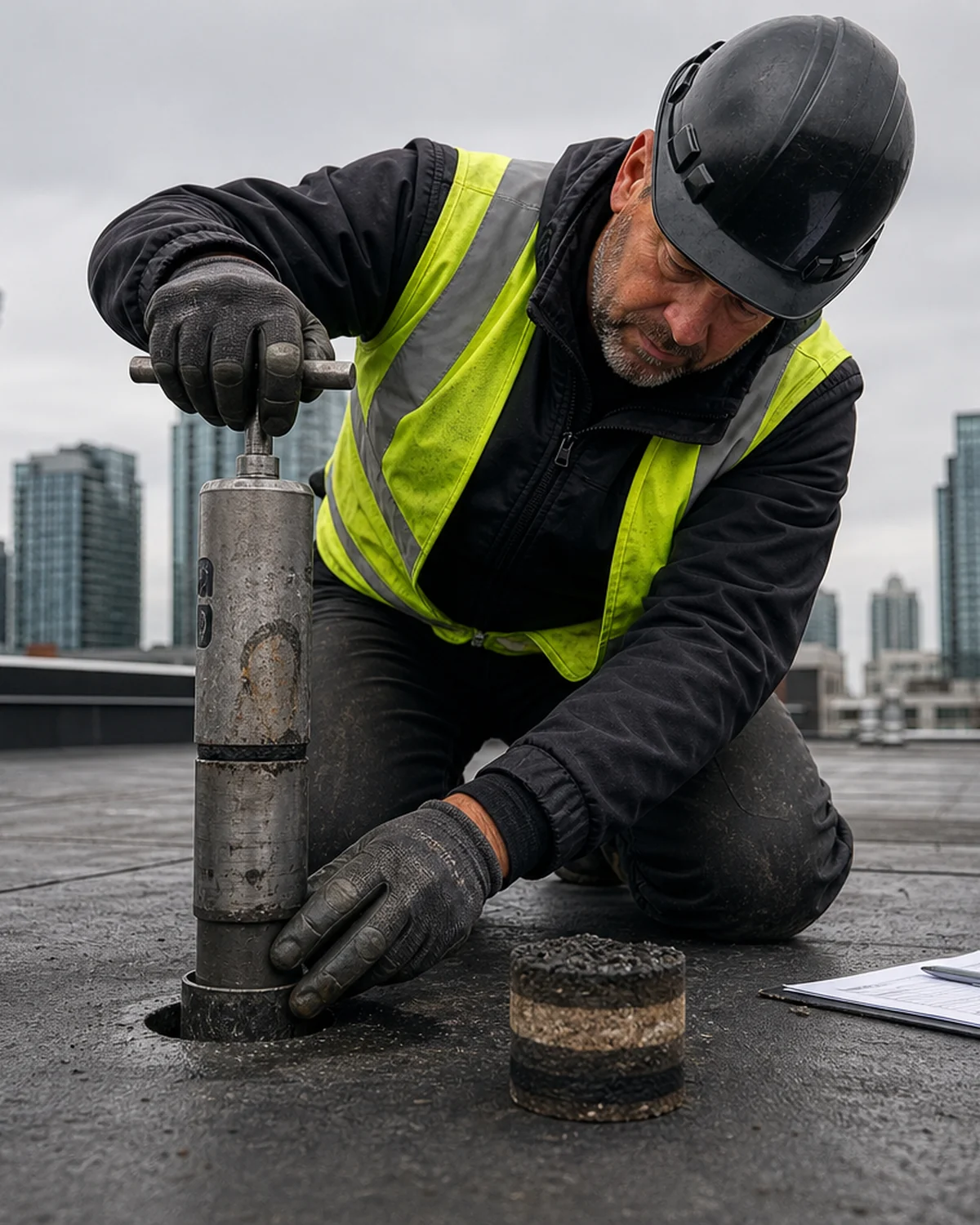
- The deck underneath is dry and solid. If a moisture scan or core cut shows dry insulation, the roof system is doing its job everywhere except the failure point.
Replacement becomes the honest answer when:
- Repairs are recurring. If you're patching the same roof every year or two, you're paying replacement money on an instalment plan and getting a failing roof for it.
- Water is in the insulation. Saturated insulation doesn't dry out under a membrane. It loses R-value, rots the deck, and turns every future repair into a guess about where the water is travelling.
- The membrane itself is at end of life — shrinking and bridging at corners, alligatoring, seams letting go in multiple places, or ponding zones where the surface has visibly degraded.
Our rule of thumb: when the cost of the current repair plus the repairs you can already see coming exceeds about a third of replacement cost — or when there's water in the insulation — repair money is being wasted.
EPDM vs. TPO vs. modified bitumen
Three membranes cover the overwhelming majority of flat roof replacement in Toronto. All three work when installed properly. The differences are lifespan, surface temperature, repairability, and how each handles our climate:
| Membrane | Lifespan | Installed cost | Best use |
|---|---|---|---|
| EPDM (black rubber) | 25-30 years | $8-$12 per sq ft | Big open roofs, durability, easy future repairs |
| TPO (white thermoplastic) | 20-25 years | $9-$13 per sq ft | Commercial roofs where cooling load matters |
| SBS modified bitumen | 15-20 years | $9-$14 per sq ft | Residential flat roofs, high-traffic details, freeze-thaw |
EPDM is a black synthetic rubber sheet, and its virtues are simplicity and longevity. It stays flexible for decades, it shrugs off UV, and — this matters more than buyers realize — it's the easiest membrane to repair ten or twenty years in. A future patch on EPDM is a primed rubber patch, done in an hour. The trade-off is the black surface: it absorbs heat, which adds to cooling load on conditioned buildings and cooks rooftop mechanicals in July.
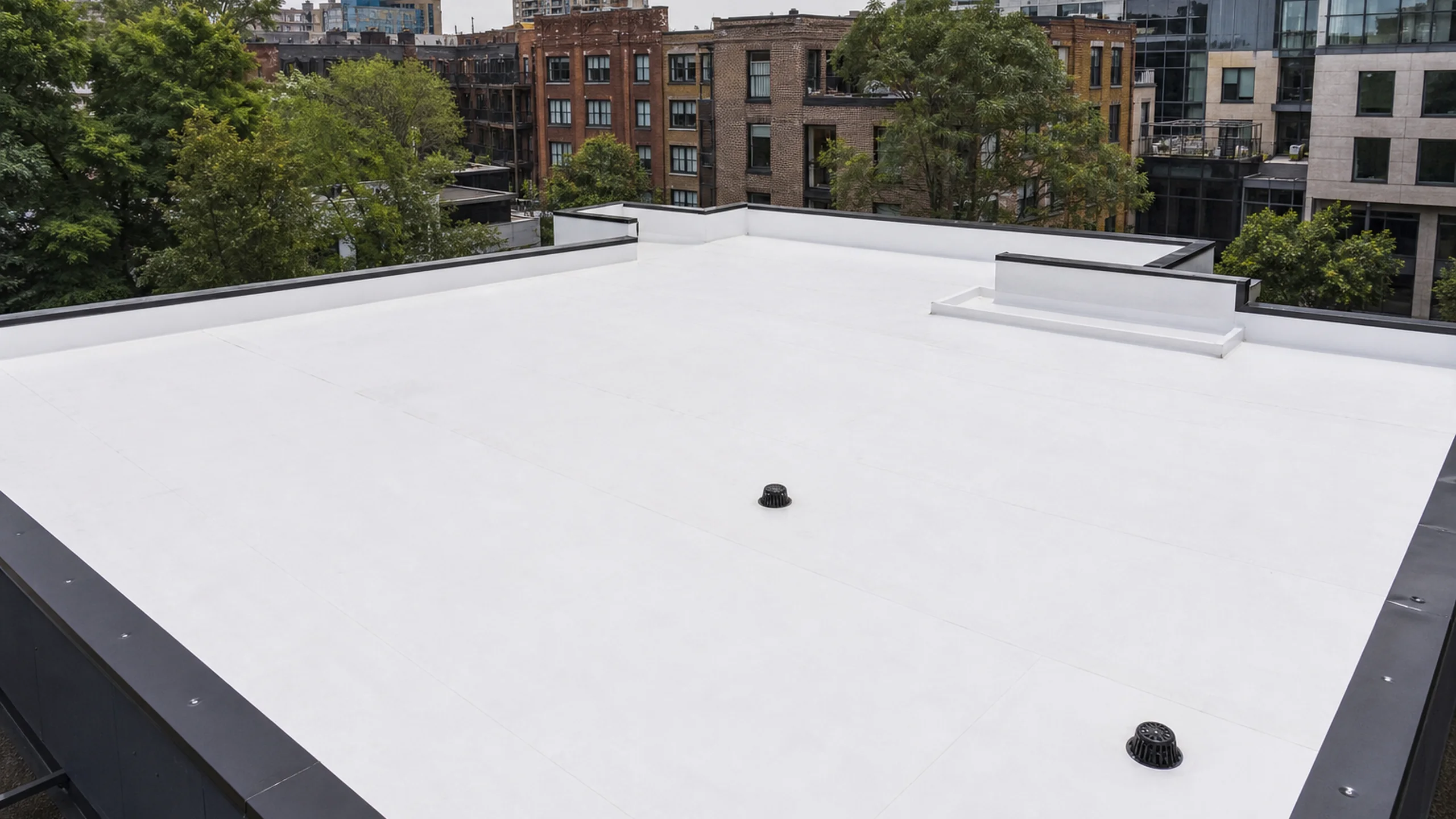
TPO is a white, heat-welded thermoplastic membrane. Its seams aren't glued — they're welded into a single monolithic sheet, which done properly makes the seam stronger than the field. The reflective white surface keeps the roof dramatically cooler, which is why it dominates commercial work. The caveat we always give: TPO quality varies significantly by manufacturer, so spec it by name, not by the word 'TPO' on a quote.
SBS modified bitumen is rubberized asphalt, applied in two torch- or heat-welded layers. It's the heaviest and most puncture-resistant of the three, it handles foot traffic well, and the SBS rubber modification keeps the asphalt flexible in cold weather — which is why it's our usual recommendation for residential flat roofs in Toronto, where freeze-thaw cycling is the dominant stress and roof decks, additions, and porch roofs see people walking on them. The trade-off is a shorter lifespan than the single-ply options and more seams in the system.
Ponding water and re-sloping
No membrane choice fixes a roof that doesn't drain. Ponding water — standing water still on the roof 48 hours after rain — degrades every membrane on the market: seams sit submerged, UV works on the wet surface, and the water's weight deflects the deck further, which deepens the pond, which collects more water. It's a feedback loop, and patching over it treats none of it.
We wrote up a full example of this in our Midtown Flat Roof case study: a commercial building where two previous contractors had patched the visible leak while water sat centimetres deep across a quarter of the roof. The deck had settled away from the drains, so the roof was draining toward its own middle. The fix wasn't a better patch — it was pulling the membrane, building a positive slope with tapered insulation (a quarter inch of fall per foot toward the drains), adding two drains at the low zones, and then installing the new TPO over a roof that finally shed water. Six months later: no ponding, no leaks.
The lesson generalizes. If your flat roof ponds, a replacement quote that doesn't address slope is a quote to install a new membrane into the same failure conditions that killed the last one. Tapered insulation adds real cost — but it's the difference between a roof that lasts its rated life and one that starts dying the first week.
What a replacement actually involves
A proper flat roof replacement is a system rebuild, not a membrane swap. The sequence:
- 01
Tear-off or overlay decision. An overlay (new membrane over the old roof) is cheaper and sometimes legitimate — but only if a moisture scan confirms the existing insulation is dry and the deck is sound. Overlaying wet insulation seals the rot in. We tear off whenever there's moisture in the system, more than one existing roof layer, or a deck we can't otherwise verify.
- 02
Deck inspection and repair. With the roof open, every soft or rusted section of decking gets replaced. This is the line item that varies on-site — and a fair contract prices deck replacement per sheet up front rather than springing it mid-job.
- 03
Insulation — and the upgrade opportunity. This is the one moment in the building's life when adding insulation is nearly free labour: the roof is already open. Stepping up polyiso thickness costs materials only, cuts heating and cooling load every year after, and can bring an older building toward current energy code. If drainage needs fixing, tapered insulation handles slope and R-value in one layer.
- 04
Membrane installation. Field sheet fully adhered or mechanically fastened per spec, seams welded (TPO) or lapped and torched (mod-bit), perimeters secured, every penetration flashed with manufactured boots — not caulk.
- 05
Details and documentation. Parapet flashings, drain tie-ins, walk pads to mechanical units, and a photo record of the deck, insulation, and seams before they're covered.
Each stage is a place a low bid can quietly cut. The membrane brand on the quote tells you less about the roof you'll get than what the quote says about the four stages before it.
Commercial and multi-unit flat roofs
Commercial roofing in Toronto adds a layer of requirements that have nothing to do with the membrane and everything to do with the building staying in business while the work happens. If you manage a commercial property or a multi-unit residential building, the contractor's process matters as much as their materials:
- Written condition reports. Property managers answer to owners, boards, and insurers. Every assessment we do on a commercial roof produces a written, photo-documented report — membrane condition, seam condition, drainage performance, deck moisture findings — that can go straight into a reserve fund study or an insurance file.
- Occupied-building staging. Tenants don't close for a reroof. That means sequencing the roof in zones so the building is always watertight, ending every workday with a sealed tie-in regardless of the hour, craning materials in measured daily loads rather than stockpiling them overhead, and coordinating rooftop HVAC shutdowns in short scheduled windows with building management.
- Predictable budgeting. Multi-year capital planning needs honest numbers: what the roof needs now, what it will need in five years, and what deferring costs. A good flat-roof contractor gives you the repair-versus-replace math in writing rather than defaulting to whichever answer is larger.
- Warranty paperwork that survives turnover. Manufacturer warranties registered in the owner's name, workmanship warranty in writing, and a maintenance schedule the next property manager can actually follow.
Ask any bidder how they handle daily tie-ins and weather contingency on a multi-day install. The answer separates contractors who have done occupied buildings from contractors who are about to learn on yours.
Toronto freeze-thaw and your membrane
Toronto's climate is uniquely hard on flat roofs for one reason: we cross zero degrees dozens of times every winter. Each crossing is a cycle — meltwater finds a seam edge, a fastener, a hairline in a flashing, then freezes and expands. Whatever opening it found gets incrementally larger, and the next melt delivers more water to it.
What that means for each membrane:
- Seams take the damage first. Freeze-thaw attacks the joints between sheets, which is why heat-welded TPO seams (a monolithic weld, not an adhesive joint) and the rubberized flexibility of SBS mod-bit both matter here. Cold-weather flexibility is exactly what the SBS modification adds to asphalt — unmodified asphalt goes brittle in the cold and cracks under thermal movement.
- Ice loads the drains. Snowmelt refreezing at drains and scuppers dams the roof's exits, backing meltwater up over flashings that were never designed to sit underwater. This is why winter drain checks are on every maintenance schedule we write.
- Thermal movement works the details. A membrane swings through a huge surface-temperature range between a sunny February afternoon and that night — black EPDM more than reflective TPO. The membrane is engineered for that movement; badly terminated edges and caulked-instead-of-flashed penetrations are not. Freeze-thaw finds sloppy details within a couple of winters.
The practical takeaway: in this climate, installation quality outweighs membrane brand. A mid-tier membrane with welded seams, proper terminations, and real slope will outlive a premium sheet installed over ponding water with caulked details — every time.
How to compare flat-roof quotes
Flat-roof quotes are hard to compare because the membrane name on page one hides the scope differences on page two. Line the quotes up and check:
- 01
Tear-off or overlay — stated explicitly. If one quote is a tear-off and another is an overlay, they're different projects with different lifespans. An overlay quote should come with moisture-scan evidence that overlaying is legitimate.
- 02
Membrane spec, not just type. Thickness (a 60 mil sheet is not an 45 mil sheet), manufacturer, and attachment method (fully adhered vs. mechanically fastened) all belong in writing.
- 03
Insulation and slope. Does the quote state the insulation type, thickness, and R-value? If the roof ponds, is tapered insulation included — or is the new membrane going into the same swamp?
- 04
Deck repair pricing. Per-sheet decking replacement priced up front, so mid-job discoveries have a known cost instead of a renegotiation.
- 05
Details itemized. Drains, parapet flashings, penetration boots, walk pads. 'Flash all penetrations' as a line item beats silence.
- 06
Warranty, in both halves. The manufacturer's membrane warranty *and* the contractor's workmanship warranty, in years, in writing. The second one is the one that covers the seams.
A $9-per-foot quote and a $13-per-foot quote on the same building are rarely the same roof. Usually one includes slope correction, thicker insulation, and honest detail work — and one is a membrane stretched over whatever is already up there. Get the scopes to match before you compare the numbers, and the right choice tends to make itself.
Filed under
Blue Knight Roofing
Building-envelope specialists across the GTA since 1999.