Key takeaways
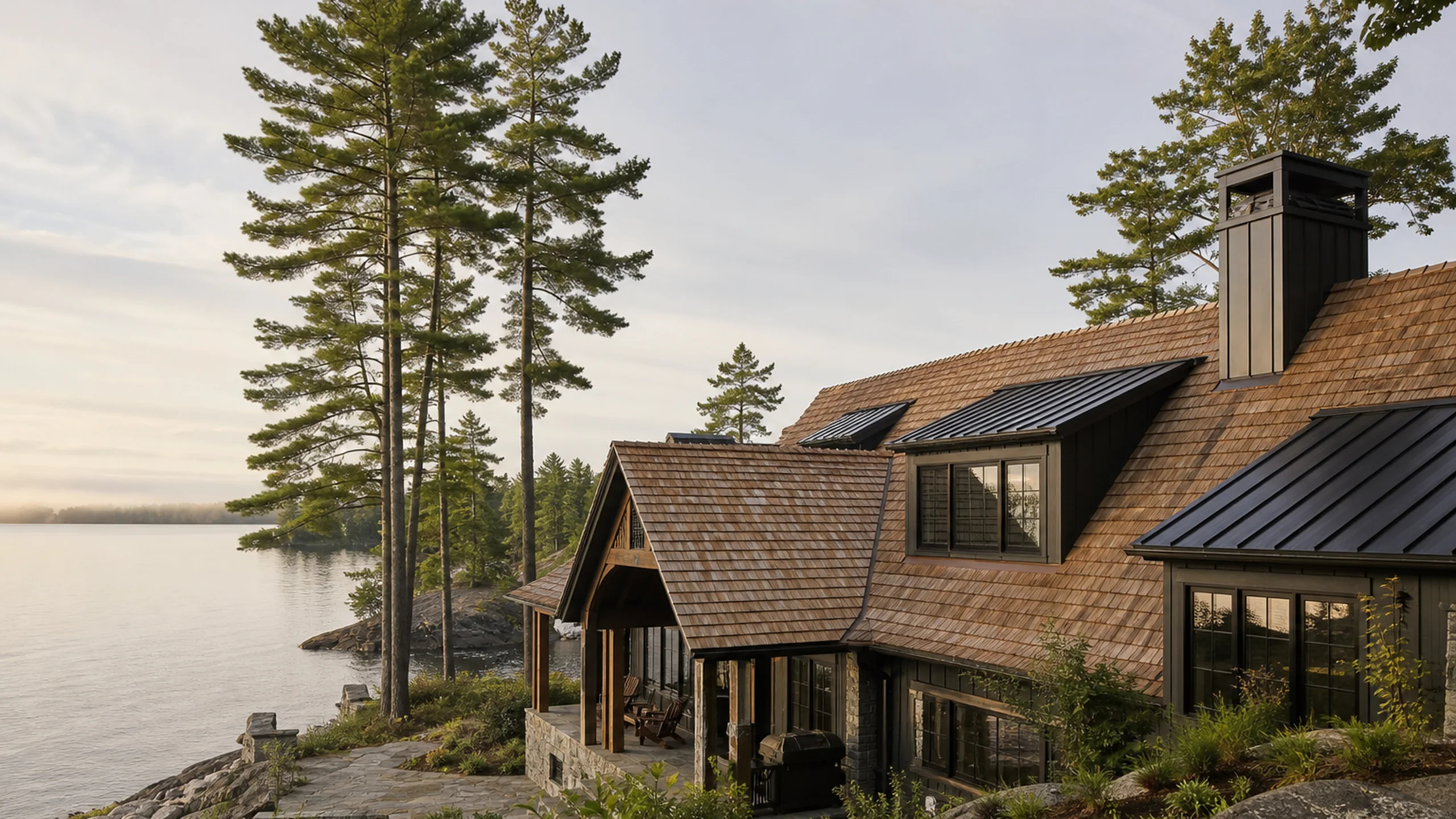
- Hand-split cedar shakes on the main body of the home, standing-seam steel on the lower-slope covered porches.
- The hybrid wasn't aesthetic indulgence — it was engineering: cedar fails fast on shaded, low-slope surfaces.
- Cedar specced at 5/8 inch hand-split shakes on a fully ventilated nail base, not laid directly on solid deck.
- Steel was 24 gauge in a matte slate-grey finish, hidden-fastener standing seam.
- Expected lifespan: 40-50 years on the cedar with maintenance, 50+ on the steel.
Where cedar earns its keep — and where it fails
Cedar shakes are the most beautiful roof material that exists for cottage country — and the most punishing to specify badly. They're a natural product that breathes, which means they shed water by being able to dry between rains. Take that drying away and they rot.
Where cedar works:
- Steep slopes (8/12 pitch or greater) that shed water fast
- Sun-exposed surfaces that dry quickly after rain
- Properly ventilated roof assemblies (not laid on solid deck)
Where cedar fails:
- Shaded slopes where moss and algae take hold
- Low pitches that hold water against the shake
- Unventilated decks that trap moisture from below
The hybrid rule we use up north
On this Muskoka retreat, the main body of the house has a 9/12 pitch facing south and west — full sun exposure, fast drying, steep enough to shed everything that hits it. Textbook cedar territory.
The covered porches that wrap two sides of the house are a different story: 4/12 pitch, partially shaded by mature pines, and lower to the ground where humidity sits. Cedar there would have been moss-covered inside five years and rotting inside ten.
Our rule, refined over twenty-five years of cottage roofs: if a slope can't dry within 48 hours of a soaking rain, it's not a cedar surface. Match the material to the microclimate of each plane.
Hand-split shake details that matter
Not all cedar shakes are the same product. Three details we specced:
| Detail | Spec | Why |
|---|---|---|
| Grade | Number 1 hand-split, certi-split | Lower grades fail decades sooner |
| Thickness | 5/8 inch (heavy) | Thicker shakes resist cupping |
| Substrate | Battened over solid deck — air gap under shake | Allows underside drying |
| Underlayment | 30 lb felt, no synthetics under cedar | Synthetics trap moisture against the wood |
| Fasteners | Hot-dipped galvanized or stainless |
The battened substrate is the detail most contractors skip. Laying cedar on solid deck is faster and cheaper — and it kills the roof a decade early. The shakes need to breathe from below as well as above.
Standing-seam details that matter
Standing-seam steel is the right answer on a shaded low-slope porch, but it has its own failure modes if it's specced wrong:
- Gauge matters. We use 24 gauge minimum on cottage country roofs. 26 gauge is what bargain bids quote — it oil-cans (visible waviness) and dents under hail.
- Hidden fasteners only. Exposed-fastener steel uses screws through the face of the panel that work loose over freeze-thaw cycles. Standing-seam hides the fasteners under the rib.
- PVDF (Kynar) paint finish. Cheaper polyester paints fade in 10-15 years; Kynar holds colour for 30+.
- Snow retention engineered to plane. Steel sheds snow violently — we calculated and installed snow guards above the porch entries so a metre of snow didn't avalanche onto guests.
Cost and expected lifespan
Both materials cost significantly more than asphalt up front. The lifespan math is what justifies them:
| Material | Installed cost (relative) | Expected lifespan | Cost per year of service |
|---|---|---|---|
| Architectural asphalt | 1.0x baseline | 20-25 years (cottage country) | Highest per-year |
| Hand-split cedar (specced right) | 2.5-3x | 40-50 years with maintenance | Mid |
| Standing-seam steel (24 ga, PVDF) | 2.5-3.5x | 50+ years |
For a property the owner intends to keep in the family, the lifecycle cost on cedar and steel beats asphalt — and the resale story is materially different.
What the owner has to do annually
Cedar isn't no-maintenance. Real talk for any owner considering it:
- 01
Annual debris clear in fall (pine needles in shake gaps trap moisture).
- 02
Visual inspection every spring for moss or lifted shakes.
- 03
Treatment every 5-7 years with a borate-based wood preservative (kills moss spores, slows UV greying).
- 04
No pressure washing — ever. It strips the surface lignin and dramatically shortens lifespan.
Steel maintenance is functionally zero — annual gutter clear and a visual look at panel fasteners. That's part of why the hybrid worked: the porches that get the most foot traffic and visibility also need the least maintenance.
Filed under
Blue Knight Roofing
Building-envelope specialists across the GTA since 1999.