
Roof Repair in Lawrence Park
Multi-slope Lawrence Park rooflines, original chimney masonry, valley drainage issues, we trace and fix the actual source.
Roof Repair in Lawrence Park, what we fix.
Roof leak repairs
Emergency tarping
Storm damage repair
Shingle repairs & replacement
Metal roofing
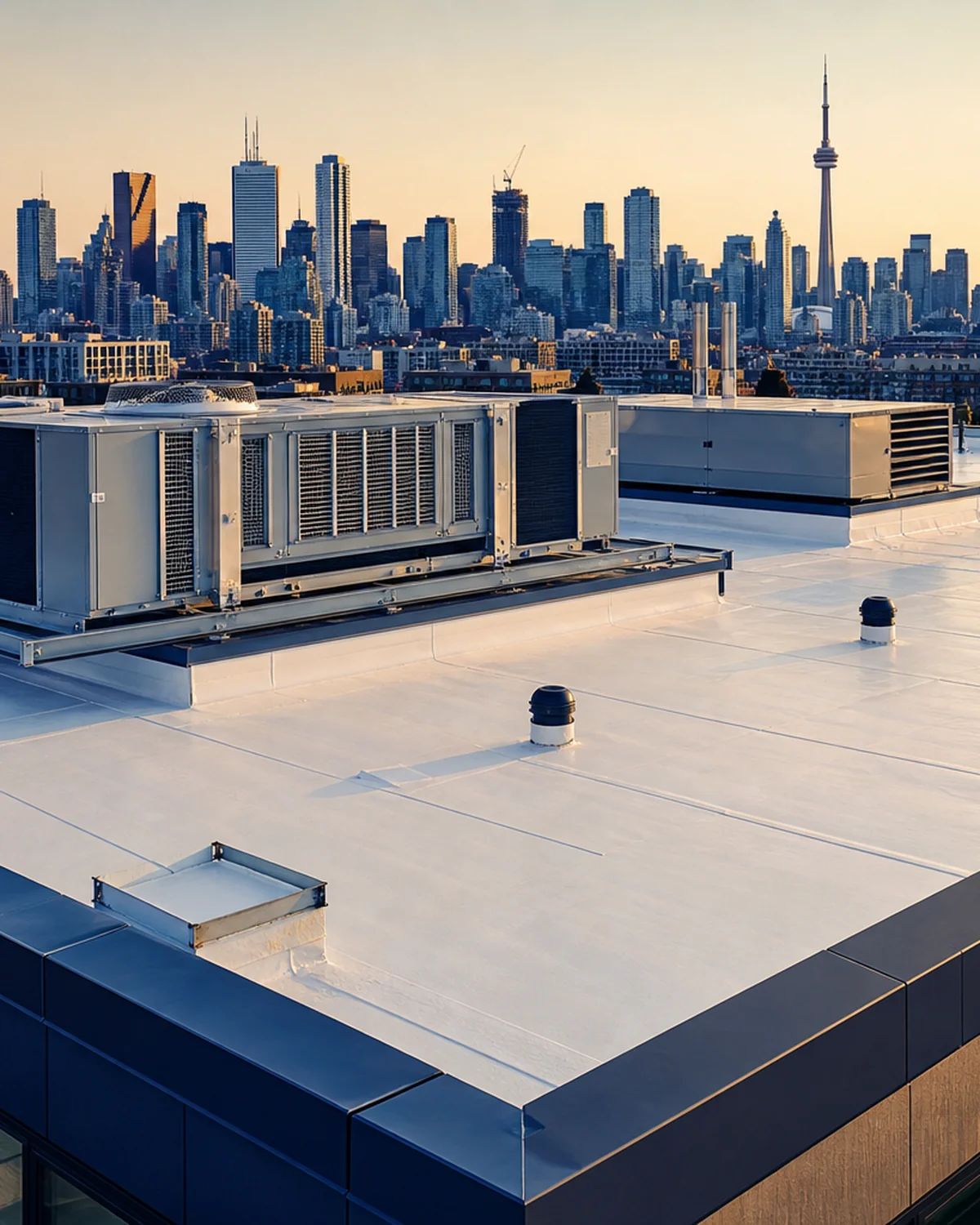
Flat roof repairs (EPDM, TPO, Mod-Bit)
Why Blue Knight finds it when others don't.
We trace first
Written reports
25+ years experience
No upsells
60-min emergency
Permanent repairs
We trace first
Every job starts with a full trace from interior stain back to the roof. We find the source before touching anything.
Written reports
You receive a written diagnostic report with photos, suitable for insurance, lenders, and property management files.
25+ years experience
Two and a half decades on GTA roofs means we've seen every failure mode across every building type in the region.
No upsells
We don't sell replacements when repairs are appropriate. Our invoice reflects what the building actually needs.
60-min emergency
Active leaks get same-day priority dispatch, around the clock, including nights and weekends.
Permanent repairs
We use manufacturer-matched materials and test the repair before we leave. No waiting for the next rain.
“We trace the leak from the stain back to the source. That's how leaks get fixed permanently.”
“We trace the leak from the stain back to the source. That's how leaks get fixed permanently.”
Rated 5 out of 5Blue Knight was, by far, the best. Responsive, ethical, totally professional — and their crew went above and beyond at no extra charge.
Rated 5 out of 5They installed a full new roof in one day. The crew worked around the house without us hardly knowing they were there.
Rated 5 out of 5I emailed at 4 a.m. and spoke with someone that same day. Estimate and completed work all within one day. Pricing was fair, work was excellent.
Blue Knight was, by far, the best. Responsive, ethical, totally professional — and their crew went above and beyond at no extra charge.
They installed a full new roof in one day. The crew worked around the house without us hardly knowing they were there.
I emailed at 4 a.m. and spoke with someone that same day. Estimate and completed work all within one day. Pricing was fair, work was excellent.
Luciano did not try to sell me a new roof. Appreciated the honesty — he showed up when he said he would.
We had a leak diagnosed by two other contractors who could not find the source. Blue Knight found it on the first visit and fixed it the same week.
Flat roof replacement on a commercial unit. Clean, fast, no surprises on the invoice. The crew left the site cleaner than they found it.
Called after a storm damaged our roof. Someone was on site within hours, tarped everything, and had us fully repaired before the next rain.
Had a slow basement leak for years. Every other company just caulked it. Blue Knight found the actual source and did a proper waterproofing job. No issues since.
Our neighbours recommended them for a valley repair. Small job, but they treated it like it mattered — showed up on time, matched the shingles perfectly, and charged exactly what they quoted.
Our Work.
Rooftops across the GTA.
From downtown Toronto to the 905 and beyond, one crew, one warranty, twenty-five years of GTA rooflines.
Service availability may vary. Call (647) 383-8664 to confirm coverage for your area.
Rooftops across the GTA.
From downtown Toronto to the 905 and beyond, one crew, one warranty, twenty-five years of GTA rooflines.
Service availability may vary. Call (647) 383-8664 to confirm coverage for your area.
Roof Repair questions for Lawrence Park.
Yes, and on these roofs most of the work is tracing. A leak under a multi-valley roofline can start at a dormer cheek, a buried valley, or a chimney well away from the stain, so we follow the water back to the intersection that failed and repair that detail rather than replacing whichever shingles happen to sit nearest the ceiling mark.
Yes. On any repair that touches a drainage path we clear the valleys, the gutters, and the pocket behind the chimney, because under the Lawrence Park canopy packed leaf litter is often what pushed the water under the shingles in the first place. Clearing it also lets us see whether the valley metal underneath is still sound.
Most repairs are completed in half a day to one full day once we know what failed. Chimney work that needs repointing before the flashing goes back, or a valley that has to be opened up on both sides, can run longer, and the written estimate states the expected time before we start.
Yes. Every repair comes with a written report and dated photos showing what we found, what failed, and what we replaced, including the flashing and underlayment that end up hidden beneath the finished surface. It is worth keeping for a sale, an insurance claim, or the next contractor who needs to know what sits under the shingles.
Yes. Sunrooms and enclosed sleeping porches on Lawrence Park houses of this era often carry a flat or nearly flat roof, sometimes with a door opening onto it from an upstairs room. Those membranes deal with ponding and a threshold that has to be flashed properly, so we repair or replace the membrane and rebuild the door and wall junctions at the same time.
Because the repair almost certainly addressed the surface rather than the detail underneath it. Correct chimney work means counterflashing cut into a sound mortar joint and step flashing woven into the courses up each sloped side. What we usually find instead is a bead of sealant run across the brick, which has a service life of a few years against masonry that moves seasonally. When it opens, water enters behind the metal and travels down inside the wall cavity before it appears on a ceiling. Chimney flashing failure repaired properly means opening the covering back, repointing the joint, and rebuilding the metalwork.
It is usually the debris, which is good news because it is cheap to fix. Lawrence Park's canopy loads valleys and the areas behind chimneys with leaf litter and seed every year. Once it compacts, that mat stays soaked for days after a storm, and in winter it freezes into a dam that sends meltwater sideways beneath the shingle laps. The roof itself can be entirely sound. If the soaking has already softened or lifted the covering, a real repair is needed, and our report states plainly which of the two situations you are in.
It matters because of what it left behind. Cedar was laid on spaced strapping rather than solid sheathing, and when these houses were re-covered in asphalt the strapping was often sheeted over rather than replaced. That leaves a layered deck of variable thickness and support, which is why fasteners lose their grip in patches and why a foot can find a soft spot on an otherwise sound roof. It also affects ventilation, because the original assembly breathed through the shake and the replacement does not.
On a Lawrence Park house of this age, frequently two and sometimes more, and yes it changes everything. With two layers already on, another overlay is off the table, so the next roof means tearing everything back to the boards, which costs more. It also means the sheathing condition has been hidden for decades and every flashing detail sits progressively higher and shallower against the covering. During diagnosis we lift the edge at a rake or an eave to count what is there, since that count decides whether patching a slope still makes sense.
Yes, and they need to be assessed on their own terms. Rear additions, porch roofs, and bay projections on these houses often carry a low sloped or flat roof membrane, and that ages on a completely different schedule from the steep asphalt beside it. On porches and bays too shallow for shingles we fit and repair metal panels, which carry water off a low pitch far better. The junction where the low sloped section meets the main slope is a detail we expect to look at closely, because it is a common source of persistent water infiltration.
Lawrence Park's homes have complex rooflines with multiple valleys, chimneys, and dormers, all intersecting at flashing points that are primary failure locations. We trace systematically before proposing any work.
The roof geometry here is the root of most of it. A large 1920s or 1930s Lawrence Park house typically has several gables meeting at different heights, deep dormers, and one or more masonry chimneys passing through a slope rather than sitting neatly on a ridge. Every one of those intersections is a flashing detail, and flashing failures are what we are actually called to. The open field of the covering is rarely the problem.
The second factor is what has already been done. Many of these roofs began as cedar shake, were re-covered in asphalt at some point mid-century, and have been re-covered again since. Each cycle raised the surface relative to the chimney counterflashing and the wall terminations, and each one gave a contractor the opportunity to shortcut a detail that is now buried. Our written diagnosis documents exactly what failed and why, including when the honest finding is that a slope needs stripping rather than another repair.
Roof Repair for Lawrence Park Homes
Lawrence Park's roofing repair needs centre on flashing failures at chimney intersections, valley deterioration, and the cumulative effects of debris accumulation under mature tree canopy. We address all of these with diagnostic accuracy.
Honest repair recommendations, not manufactured replacement urgency. Plenty of our Lawrence Park visits finish with nothing more than a cleared valley and a confirmation that the shingles under the leaves are fine, and we would rather tell you that than convert a drainage problem into a roofing invoice.
Layered Roofs and Buried Details
Most Lawrence Park roofs are not one roof. They are a sequence of decisions made across ninety years or more, and the current covering is sitting on top of that history. Original cedar shake on spaced strapping, sheeted over for an asphalt re-cover mid-century, then re-covered again more recently, is a common profile in this neighbourhood.
Each cycle has consequences we deal with during repair. The surface rises, so counterflashing that was correctly let into a mortar joint at original height now sits too low relative to the covering. Wall terminations get shallower. Valley metal gets buried rather than replaced. Fastening becomes unpredictable where the deck is a mix of original strapping, later sheeting, and patched repairs.
So before we cut anything we establish which of those buried layers is actually carrying the water, rather than sealing whatever defect is easiest to see. Where a slope has reached the end of what overlaying can achieve, we set out the case for a full roof replacement with the reasoning written down, including the deck work we expect to find once the layers come off.
Flashing and Chimney Repair in Lawrence Park
The chimney-roof interface is the most common failure point we see on Lawrence Park homes. Counter flashings embedded in masonry, cap flashings, and chimney parging all deteriorate over time and need periodic attention.
A new strip of metal over the obvious gap is not the repair. That means the mortar joint the counterflashing sits in, the step flashing running up the sloped sides, the cricket behind any chimney wide enough to trap snow against its back face, and the condition of the masonry itself. Freeze thaw cycles work these joints apart from the top down, and a chimney with eroded bedding will keep defeating new metalwork until the masonry is repointed.
With the junction already open, and where the geometry calls for it, we lay a self-adhering ice and water shield under the new flashing before the covering goes back. It is invisible when the work is done and it is the difference between a detail that lasts a few seasons and one that lasts decades.
We also cover nearby cities.
Ready to schedule your estimate?
We come to you, assess the roof, and give you a written quote. You are not obliged to proceed. Most estimates completed same week.